BioSil Review: Reading the Clinical Trials Instead of the Marketing
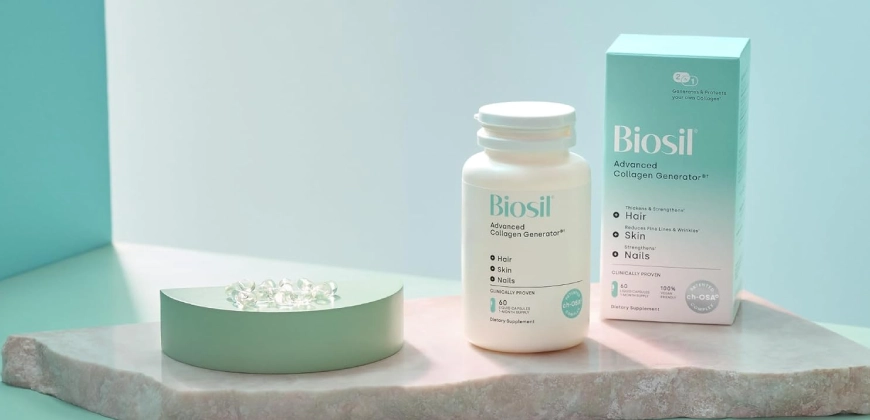
Start with the thing most buyers get wrong before they have even opened the bottle. BioSil contains no collagen.
It is marketed as an Advanced Collagen Generator, which is a careful phrase doing careful work. The active ingredient is ch-OSA, choline-stabilized orthosilicic acid, which is a bioavailable form of silicon. The claim is that silicon helps your own body build collagen, not that you are swallowing collagen. People who switch from a collagen peptide powder to BioSil expecting the same thing in a smaller dose are buying a different category of product.
That distinction decided the structure of this review. BioSil has actual published randomised trials behind it, which puts it ahead of most of the supplement aisle. It also has limitations in those trials that the marketing does not mention, including one result that runs directly against the product's own skin claims.
This is a review of the published evidence, not medical advice. Supplements interact with medications and conditions, so speak to a doctor or pharmacist before starting anything, particularly if you are pregnant, breastfeeding or taking prescription medicine.
Verdict in one minute
- There is real published trial evidence, which is rare in this category and deserves credit.
- The main hair study ran on 48 middle-aged healthy white women with fine hair for nine months, with 45 completing.
- The hair diameter result was statistically significant, but no effect size was reported, so the size of the change is unknown.
- The skin study found skin hydration decreased, which contradicts the product's own marketing.
- If you are outside the population studied, there is no evidence either way, which is not the same as evidence it works.
What the hair study actually found
The study most often cited for BioSil is Wickett and colleagues, published in Archives of Dermatological Research in 2007. Forty eight middle-aged, healthy white women with fine hair were randomised to either 10mg of oral ch-OSA daily or a placebo, for nine months. Twenty four per group. Forty five completed.
Hair diameter and tensile strength were measured at the start and the end. The ch-OSA group showed a statistically significant increase in hair diameter. The placebo group did not.
That is a genuine result from a genuine randomised controlled trial, and it should not be dismissed. Here is what it does not tell you, drawing on the analysis published by McGill University's Office for Science and Society, which went back to the underlying data.
The distributions overlap heavily
When the individual results are plotted rather than only the group averages, most of the ch-OSA results sit inside the same range as the placebo results. Plenty of women taking ch-OSA experienced the same change as women taking nothing. A group average can move while a large share of individuals see no difference, and that is what appears to have happened.
No effect size was reported
This is the most important gap. Statistical significance answers whether a change is likely to be real. Effect size answers whether it is big enough to matter. The study reports the first and not the second.
A hair diameter increase can be real, measurable under laboratory conditions, and completely invisible when you look in the mirror. The McGill assessment, having examined the data, guessed the effect was likely quite small, and concluded: can ch-OSA make your hair thicker? Maybe. But also, maybe not. And probably not by that much.
The population was narrow
Middle-aged, healthy, white women with fine untreated hair. That is who was studied. If you are male, younger, older, of a different ethnicity, have coarse hair, colour or chemically treat your hair, or are experiencing hair loss rather than fine hair, the trial says nothing about you in either direction.
Supplement marketing routinely extends a narrow finding to everybody. A trial on 48 women with fine hair is not evidence about male pattern baldness, and nothing in the published record claims otherwise.
The skin result the marketing does not mention
A separate trial examined ch-OSA's effects on skin, nails and hair. The reported outcome was a slight improvement in skin roughness, nail brittleness and hair brittleness, and a decrease in skin hydration.
Read that last part again, because it matters. The product is sold substantially on skin benefits, and the study found hydration went in the wrong direction.
The nail and brittleness improvements were also small. Nail brittleness was scored on a nought to three scale and improved by very little.
None of this makes BioSil useless. It makes the honest summary narrower than the packaging: there is modest trial evidence for hair diameter and brittleness in a specific group of women, and the skin hydration evidence is unfavourable rather than absent.
BioSil Advanced Collagen Generator, drops
Sold in 15ml and 30ml bottles. The 30ml bottle is the standard size.
The original format and the one closest to the trials. Dosing is by drops into liquid, which lets you match the 10mg daily ch-OSA dose used in the research rather than guessing.
If you decide to try BioSil, this is the format to choose, for one reason: the published evidence rests on a specific daily dose over nine months. A format that lets you replicate that dose exactly is worth more than one that does not, and nine months is the timeline you should be planning for, not six weeks.
BioSil liquid capsules
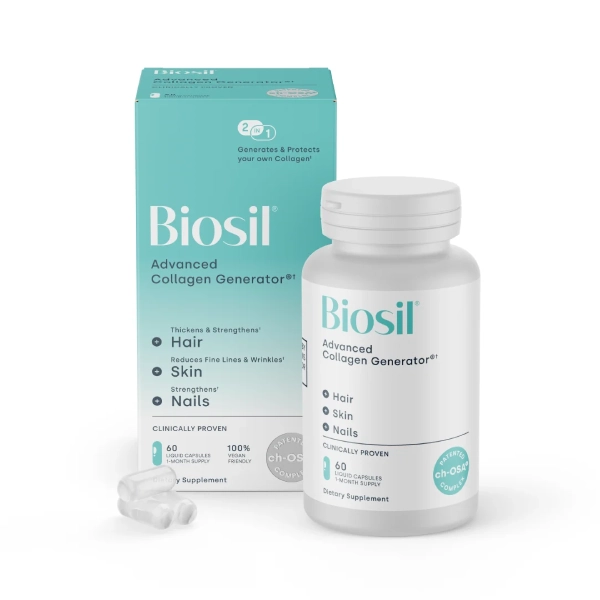
Commonly sold in 60 capsule bottles, vegan.
The same active ingredient in a capsule, for people who dislike measuring drops. Convenience is the only difference and that is a legitimate reason to pay for it, since a supplement you actually take daily beats one you abandon.
Check the ch-OSA per capsule against the 10mg trial dose rather than assuming one capsule equals one dose. Supplement brands vary servings between formats and the number on the front of the bottle is not always the number in one capsule.
BioSil Advanced Hair and Nail Care
Typically 60 capsules, combining ch-OSA with biotin.
Here the evidence gets murkier, and it is worth being clear why. Adding biotin to ch-OSA creates a product that has not been tested in the form you are buying. The trials examined ch-OSA alone.
Biotin deserves its own caution. It helps people who are genuinely biotin deficient, which is uncommon, and there is little evidence it helps hair or nails in people who are not. More importantly, high dose biotin is well documented to interfere with laboratory blood tests, including thyroid function and troponin tests used to assess heart attacks. The FDA has issued a safety communication on this. If you take a biotin supplement, tell any doctor ordering blood work, and ask whether to stop it beforehand.
That is not an argument against this product. It is a specific, practical thing to know that the label is unlikely to tell you.
How to try it properly, if you decide to
1. Use the drops and match the 10mg daily ch-OSA dose from the trials rather than a dose you invented.
2. Commit to nine months or do not start. The study ran nine months. Judging at week six tells you nothing, and most people quit before the timeline that produced the evidence.
3. Photograph a fixed patch of hair at a fixed distance in fixed lighting on day one, then monthly. Memory is a terrible instrument for gradual change in either direction.
4. Change one thing at a time. If you start BioSil, a new shampoo and a new diet in the same week, you will learn nothing about any of them.
5. Tell your doctor, especially if you choose a biotin containing version and have blood work scheduled.
Worth trying if
- You are in or close to the group studied: a woman with fine, untreated hair, and you want the one option in this category with published randomised evidence behind it.
- You understand you are buying a silicon supplement, not collagen.
- You can commit to nine months and measure properly rather than guessing.
- You accept the likely effect is small and want to try anyway, which is a reasonable position.
Skip it if
- You want collagen. Buy collagen peptides, which are a different product with their own separate evidence base.
- You are buying primarily for skin hydration. The relevant study found hydration decreased.
- You are treating hair loss rather than fine hair. That was not studied, and hair loss has causes a supplement does not address. See a doctor.
- You want a visible result in weeks. Nothing in the evidence supports that timeline.
Final word
BioSil is one of the better supported products in a weakly supported category, and that genuine credit should not be mistaken for a strong result. The trials are real, the hair diameter finding is real, and the honest reading is that the effect is probably small, the studied population was narrow, no effect size was published, and the skin hydration data points the wrong way.
If you want to try it, use the drops, match the trial dose, give it nine months and photograph the evidence. If you want something that will visibly change your hair in a month, no supplement on the market has that evidence, and this one does not claim to.
Comments (0)
All comments are reviewed and approved by an admin before appearing publicly.
No comments yet — be the first to share your thoughts.